
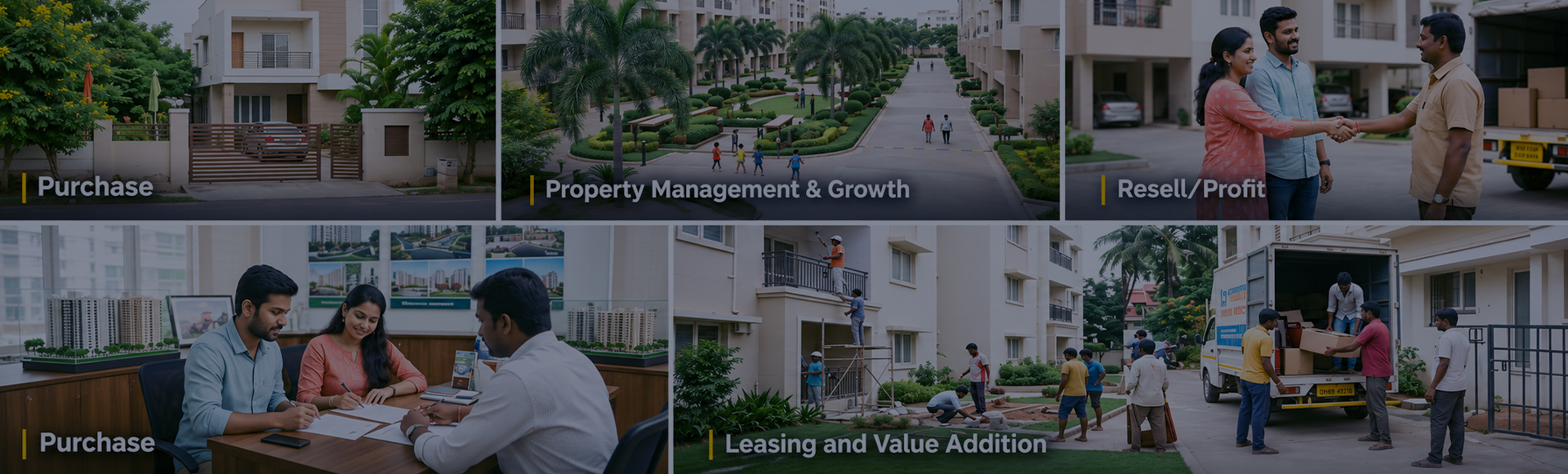
Real estate investment means buying a property to earn money from it. You make money in two ways: rental income while you hold the property, and capital appreciation when its value rises and you sell. Your real profit is what you earn from both, minus the purchase costs, loan interest, maintenance, and taxes.
In Chennai, this usually means buying an apartment, villa, or plot in a growing micro-market, paying around 11% in stamp duty and registration charges, renting it out, and holding it for several years as the area develops.
Real estate investment is the purchase of land or built property with the aim of generating income or growth in value. Unlike shares, property is a physical, location-bound asset. Its value depends on what surrounds it: jobs, transport, schools, hospitals, and future development.
Because property is expensive and hard to sell quickly, it rewards patience and careful research more than quick decisions.
Ask what you want from the property.
Set a total budget that includes the price, taxes, interiors, and a buffer, not just the base price.
Location drives almost every return. Look at nearby employers, connectivity, social infrastructure, and planned projects such as Metro Phase 2 and road upgrades.
Before paying any advance:
Many investors use a home loan. Banks commonly finance a large share of the property value, depending on the loan amount and your profile. Check that your EMI is manageable even if the property stays vacant for a few months.
You pay stamp duty and registration charges and register the sale deed at the Sub-Registrar's office. Only registration gives you legal title.
Rent the property out, or hold it while the area grows. Keep records of rent received, maintenance, property tax, and loan interest.
After several years, you can sell, move into the property, or keep renting. Time your exit around market conditions and your tax position.
Rental income. Monthly cash flow from tenants. In many Indian cities, including Chennai, residential rental yields are modest compared with the property price, so rent usually covers part of your costs rather than delivering the whole return.
Capital appreciation. The rise in value over time. This is where much of the long-term gain comes from, and it depends heavily on how the neighbourhood develops. Appreciation is never guaranteed, and some areas stay flat for years.
Most successful investors treat rent as a cushion and appreciation as the main goal.
|
Type |
Best for |
Things to watch |
|
Ready apartment |
Immediate rent |
Higher price, age of building |
|
Under-construction apartment |
Lower entry price, growth |
Delivery delays, builder track record |
|
Independent house or villa |
Long-term value, land share |
Higher budget, maintenance |
|
Residential plot |
Land appreciation |
Title clarity, approvals, no rent income |
|
Commercial space |
Higher rent potential |
Vacancy risk, larger investment |
The brochure price is not your final cost. Budget for these:
|
Cost |
Typical amount |
|
Stamp duty |
7% of the higher of sale value or guideline value |
|
Registration charges |
4% |
|
GST |
Applicable to many under-construction properties |
|
Legal and documentation fees |
Varies |
|
Interiors and furnishing |
Varies |
|
Maintenance deposit and corpus fund |
Varies by project |
|
Brokerage |
If a broker is involved |
Stamp duty is charged on the higher of the agreed price or the government guideline value, so a lower stated price does not reduce it. Tamil Nadu has also introduced a set-off mechanism that lets buyers adjust stamp duty paid on an earlier land agreement against the final payable amount. Confirm how it applies to your purchase before you register.
Suppose you buy a ₹60 lakh apartment in Chennai:
Your yearly return is rent plus appreciation, before loan interest, maintenance, property tax, and income tax. If you borrowed to buy, interest could consume much of the rent, which is why long holding periods and realistic expectations matter. These are example figures only. Actual rent and growth depend on the area and the market.
Chennai's property market behaves differently from one corridor to the next. Compare areas on these points:
Popular investor corridors include OMR, GST Road, Porur and the western and southern suburbs, each with a different price range and growth pattern. Visit the area at different times of day before deciding.
Tax rules change, so confirm the current position with a chartered accountant. In general:
Keep all purchase documents, payment proofs, and improvement bills, as they help calculate your gain.
You buy a property, pay the purchase costs, earn rent while you hold it, and aim to sell at a higher price later. Beginners should start with a ready or near-ready property in an established area, verify the legal papers, and plan to hold for the long term.
It depends on the property. Most buyers pay a down payment of roughly 10–25% and finance the rest through a loan. On top of the price, budget around 11% for stamp duty and registration, plus legal fees and interiors.
Stamp duty is 7% and registration charges are 4%, calculated on the higher of the sale value or the guideline value.
It can be, particularly when you buy in a location with strong demand and hold for several years. Returns come from rent and appreciation, but profit is not guaranteed and depends on the area, timing, costs, and taxes.
Residential rental yields in Indian metros are usually modest, often a small single-digit percentage of the property value. Check current rents for similar homes in your target area rather than relying on a general figure.
Ready properties give immediate rent and no delivery risk but cost more. Under-construction properties are often cheaper at entry but carry delay risk and delay your rental income. Check the builder's record and RERA registration in either case.
Corridors such as OMR, GST Road, and Porur, and several western and southern suburbs attract investors because of job proximity and infrastructure. The best choice depends on your budget, goal, and holding period.
Many investors hold for at least five years so that appreciation can outweigh transaction costs and the tax treatment becomes long-term. Longer holds usually smooth out short-term price swings.
Plots offer land appreciation and low maintenance but give no rent and need careful title and approval checks. Apartments provide rent and are easier to manage, but the building ages, with the land share driving long-term value.
A loan lets you invest with less upfront capital, but interest reduces your net return, and an EMI must be paid even when the property is vacant. Borrow only an amount you can service comfortably.
Search the project on the Tamil Nadu Real Estate Regulatory Authority (TNRERA) website using the builder or project name, and confirm the registration number, approved plan, and completion timeline.
Yes. Profit from the sale is taxed as capital gains. The rate depends on how long you held the property, and exemptions may apply if you reinvest. Consult a chartered accountant for your specific case.
Real estate investment works when you combine the right location, clean legal paperwork, a realistic view of costs, and enough time for the area to grow. Count the 11% stamp duty and registration, plan for vacancy and maintenance, and treat rent as a steady cushion while appreciation builds your long-term gain.
If you're planning to invest, shortlist RERA-registered projects in your budget, compare them on connectivity and rental demand, and speak to a lawyer and a chartered accountant before you commit.
