
Why buy an apartment near a metro station?
Apartments near a metro station are a smart investment because fast, predictable commuting is one of the most valued features for tenants and buyers. Easy metro access tends to support steady rental demand, quicker resale, and stronger long-term price growth than comparable homes with poor transport links. The benefit is strongest when the station is within comfortable walking distance, the line connects to major job and education hubs, and the project is legally clean.
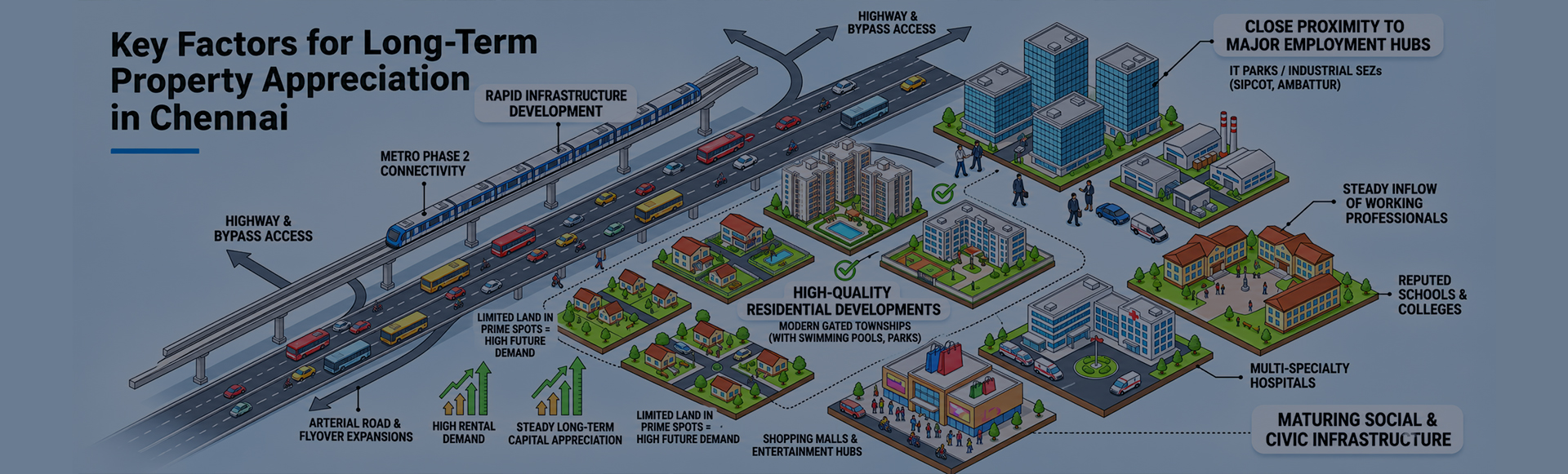
In Chennai, this matters more than ever. Phase 1 already serves the airport, Central and Guindy corridors, and Phase 2 has begun opening in the west, with the Poonamallee–Vadapalani stretch inaugurated on 11 October 2026.
People pay for time. A flat that saves a daily commuter 30 to 45 minutes in traffic is worth more to that person than a similar flat that does not. When many buyers and tenants share that preference, demand concentrates around stations, and that demand supports prices and rents.
Three forces work together:
Tenants, especially IT professionals, students and young families, shortlist homes by commute. A flat within walking distance of a station is easier to rent and may fill faster after a tenant moves out. Fewer vacant months protect your annual rental income.
When you sell, buyers ask about transport first. A property near a working station has a larger pool of interested buyers, which can shorten the time to sell and reduce pressure to cut the price.
Improved access is one of the main drivers of price growth in a micro-market. Areas that gain a metro station often see rising interest from buyers and developers. The effect is not guaranteed or instant, and it depends on how useful the line is, but locations with real connectivity tend to hold value better over long periods.
If you plan to live in the property for a few years before renting it, the commute savings are immediate. Lower travel spend makes the home more attractive and more affordable to run.
A metro line links a neighbourhood to the wider city. Homes near stations gain access to offices, colleges and hospitals without depending on a personal vehicle.
Stations bring footfall. Supermarkets, clinics, cafes and co-working spaces follow, which improves daily convenience and supports the long-term quality of the locality.
Fewer car trips mean less fuel, less parking pressure and less stress. This is increasingly a deciding factor for younger buyers and working couples.
Distance matters more than most buyers expect.
|
Distance from station |
What it usually means |
|
Up to 500 metres |
Easy walk, strongest convenience, usually the highest premium |
|
500 metres to 1 km |
Comfortable walk or a short feeder ride, often the best balance of price and access |
|
1 to 2 km |
Needs an auto, bus or two-wheeler for the first or last mile |
|
Beyond 2 km |
Metro benefit becomes limited |
The walking distance on paper is not the same as on the ground. Check the actual route, footpaths, crossings, street lighting, and whether the station entry is on your side of a main road.
Chennai Metro Phase 1 runs on two main corridors, one between Wimco Nagar and the Airport and another between Chennai Central and St Thomas Mount, with major interchanges at Central and Alandur. Neighbourhoods along these lines, such as Anna Nagar, Guindy, Alandur, Koyambedu and Nanganallur, already have established rental and resale markets with proven metro demand.
Phase 2 adds about 118.9 km across three corridors (Corridor 3, Corridor 4 and Corridor 5). It is being delivered in stages, with the full network planned over the coming years.
Because timelines for the remaining stretches can shift, buy near a station only after confirming that the specific station you are counting on is operational or has a credible, officially announced opening date.
Consider two similar 2 BHK apartments priced at ₹60 lakh each in the same part of Chennai, one a 10-minute walk from a working metro station and one needing a long auto or bus ride:
These figures are examples only. Actual rents and resale outcomes depend on the locality, the builder, the building condition, and market timing.
|
Factor |
Flat near metro |
Flat far from metro |
|
Commute |
Fast and predictable |
Depends on traffic |
|
Rental demand |
Usually stronger |
Usually weaker |
|
Resale pool |
Wider |
Narrower |
|
Entry price |
Often higher |
Often lower |
|
Growth drivers |
Connectivity and area upgrade |
Depends on other infrastructure |
|
Main risk |
Noise, crowding, overpaying |
Slower rent and resale |
Metro proximity helps, but it is not a guarantee of profit.
They save commuters time and money, which keeps rental and resale demand strong. Better connectivity also encourages retail and services to develop nearby, which can support long-term value growth.
Often yes, especially within walking distance of an operational station. The premium varies by area and by how useful the line is, so compare similar homes at different distances before paying more.
For the best balance of convenience and price, aim for up to 1 km, ideally within a 10 to 12 minute walk. Homes within 500 metres usually cost the most. Beyond 2 km, the metro benefit drops.
They often rent faster and can command a modest premium because tenants value the commute. Exact rent depends on the locality, size, amenities, and condition of the flat.
Buying earlier can mean lower prices, but you carry the risk of delay or changed plans. Buying after opening costs more but removes uncertainty. Many buyers choose projects where the station is close to opening and officially confirmed.
Phase 1 areas like Anna Nagar, Koyambedu, Guindy and Alandur have established metro demand. In the west, Porur, Iyyappanthangal, Kattupakkam and Poonamallee now have Phase 2 access. Always confirm the exact station and distance for any project you consider.
The Poonamallee Bypass–Vadapalani stretch of Corridor 4 was inaugurated on 11 October 2026, with 11 stations. Other Phase 2 stretches are scheduled in later stages, so check CMRL for current status.
Possible downsides include noise, vibration, crowding, and construction disruption. Choosing a floor and tower a little away from the track, and visiting at peak hours before buying, helps you avoid these.
No. Prices depend on the whole micro-market: jobs, supply, builder quality, and the economy. A metro link improves the odds, but it does not guarantee returns.
Yes, in most cases. Easy commuting attracts working tenants and students, which can reduce vacancy. Check current rents for comparable flats to set realistic expectations.
Check the official Chennai Metro Rail Limited (CMRL) route maps and announcements rather than relying on brokers or advertisements. Then visit the site and confirm the station's entry points and walking route.
Review the title deed, encumbrance certificate, approved plan, TNRERA registration, and the builder's delivery record. In Tamil Nadu, there is also a budget for stamp duty and registration charges of about 11% of the higher of the sale value or guideline value.
Ready flats give immediate rent and no delivery risk. Under-construction flats may cost less initially but carry the risk of delays. Check the builder's record and RERA details either way.
Many investors hold for at least five years so that connectivity-led growth can outweigh transaction costs. Longer holds usually help smooth out short-term price movements.
Apartments near metro stations are a smart investment because people will pay for connectivity every day. A flat that is easy to reach, easy to rent, and easy to resell is a more resilient asset. The best results come from buying close enough to walk to the station, on a line that actually connects to jobs and education, in a legally clean project, at a price that does not already assume the hype.
If you are considering flats near a metro station in Chennai, shortlist RERA-registered projects within 1 km of an operational or confirmed station, compare them against nearby options, and speak to a lawyer and a financial advisor before you commit.
